Macarons: A Practical Guide to Flavours, Storage, Pricing & Ordering
By Daniel Foster · Published · Updated · 4 min read
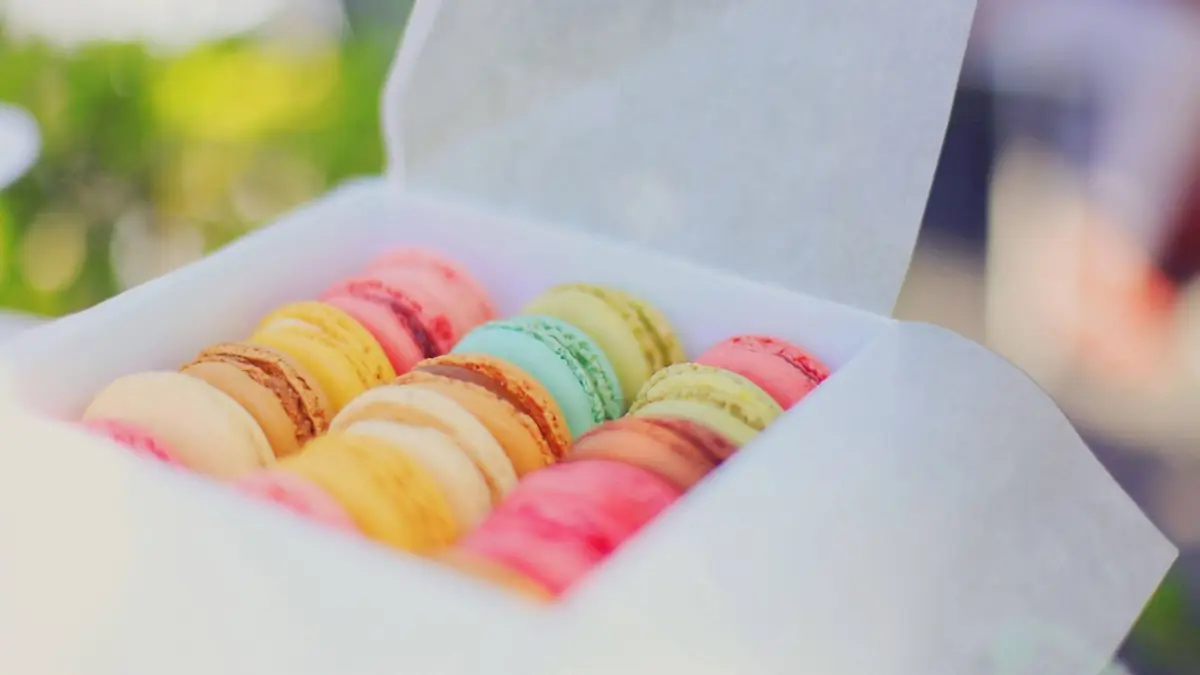
Macarons look simple: two crisp shells and a soft filling. In practice, they are one of the fussiest things a pastry kitchen makes. Shells depend on stable meringue, precise folding and a proper rest before baking, and fillings have to be soft enough to meld but firm enough to hold. That labour is the main reason a good macaron costs more than most cookies.
This guide covers what actually matters when you buy them: which flavours hold up, how to store and serve them, what prices to expect, and how many to order per guest. If you are planning a wedding or a large event, the numbers below will help you budget without guesswork.
What Makes a Good Macaron
A well-made macaron has a smooth, domed shell with a ruffled 'foot' at the base, a thin crisp exterior that gives way to a slightly chewy centre, and a filling that is flavourful without being wet. If the shell cracks across the top, the oven was too hot or the batter was undermixed. If the foot spreads outward like a skirt, the batter was too loose or the shells did not rest long enough before baking.
Filling matters as much as the shell. Ganache, buttercream and fruit curd behave differently over time: ganache sets firm and travels well, buttercream stays soft and takes flavour well, and curd can make shells soggy within a day. A good kitchen matches the filling to how the macaron will be stored and served, not just to how it looks in a display case.
- Smooth, uncracked shells with a visible foot
- Filling flush with the shell edge, not bulging
- No soggy base when you pick it up
- Flavour that tastes like what it says on the label
Flavours That Work and Flavours That Don't
Classic flavours sell for a reason: vanilla, pistachio, salted caramel, raspberry, lemon and chocolate are reliable and appeal to most guests. For events, it is worth balancing rich flavours with sharp or fruity ones so a mixed box does not taste heavy. A common ratio is roughly half classics, a quarter fruit, and a quarter something darker like coffee or dark chocolate.
Delicate flavours are where things go wrong. Rose, lavender and elderflower can taste like soap if overdone, and very wet fruit fillings shorten shelf life. If you want a subtle floral flavour, ask for it in a ganache rather than a cream, and plan to serve those pieces within a day or two. Strong flavours like passionfruit, espresso and salted caramel tend to hold up best in warm weather and during transport.
- Reliable: pistachio, salted caramel, raspberry, lemon, dark chocolate
- Handle with care: rose, lavender, elderflower, fresh berry curd
- Good for warm days: ganache-based fillings, nut pastes
- Ask for a tasting box of six to eight flavours before committing
How to Store and Serve Macarons
Macarons are best after a short rest in the fridge, often called maturation, which lets the filling soften the shell slightly. Most kitchens recommend 12 to 24 hours in an airtight container in the fridge before serving. After that, they keep well for about three to five days refrigerated, depending on the filling. Bring them out 15 to 20 minutes before serving so the texture is right.
Freezing works if you plan ahead. Wrap them tightly and freeze for up to a month, then thaw overnight in the fridge still wrapped so condensation forms on the wrapping rather than the shells. Avoid stacking them more than two deep without parchment between layers. For a full walkthrough, see How to Store Macarons So They Stay Crisp for Days.
- Fridge: 3–5 days in an airtight container
- Freezer: up to 1 month, thaw overnight in the fridge
- Serve at cool room temperature, not straight from the fridge
- Keep away from strong smells; shells absorb odours
Macaron Pricing: What to Expect
Prices vary by city, kitchen size and flavour, but the ranges are fairly consistent. Single macarons typically run from about $2.50 to $4.50 each, with most studios landing around $3 to $3.75. Boxes of six usually cost $16 to $24, and boxes of twelve $30 to $45. Larger event orders often get a small per-piece discount once you pass 100 pieces.
Wedding and event towers are priced differently because they involve structure, delivery and setup. A 60-piece tower might be quoted at $220 to $320 including the stand hire and delivery within a local radius. If you want a deeper breakdown of why the per-piece price sits where it does, read Macaron Pricing Explained: Why Do They Cost So Much?.
- Single macaron: roughly $2.50–$4.50
- Box of 6: about $16–$24
- Box of 12: about $30–$45
- Event orders over 100 pieces: ask about a 5–10% discount
| Order size | Typical price range | Best for | Notice needed |
|---|---|---|---|
| 6-piece box | $16–$24 | Tasting, small gift | 3–5 days |
| 12-piece box | $30–$45 | Hostess gift, small celebration | 1 week |
| 50 pieces | $130–$190 | Office party, shower | 2 weeks |
| 100 pieces | $240–$360 | Wedding dessert table | 2–3 weeks |
| 250 pieces | $575–$900 | Large wedding, favours | 3–5 weeks |
| 60-piece tower | $220–$320 | Wedding centrepiece | 4–6 weeks |
How Many Macarons to Order
For a dessert table, plan on two to three macarons per guest if there are other sweets, and four to five if macarons are the main dessert. For favours, one or two per guest is plenty, and a box of two is a common choice because it looks generous without pushing the budget. Always round up: guests take more than they eat, and running out looks worse than having leftovers.
For a 100-guest wedding with a cake and a dessert table, 200 to 250 macarons is a sensible starting point. If macarons replace the cake entirely, budget closer to 400 to 500 pieces, plus a small cutting tier if you still want the cake-cutting moment. If you are pairing macarons with a tiered cake, the wedding cake cost guide will help you balance the two.
- Dessert table alongside cake: 2–3 per guest
- Macarons as the main dessert: 4–5 per guest
- Favours: 1–2 per guest
- Add 10% buffer for breakage, staff and extras
Ordering and Transport Tips
Order at least two to three weeks ahead for standard flavours and four to six weeks for custom colours, printed shells or large towers. Busy wedding season fills up earlier, so if your date is in spring or early autumn, book sooner. Confirm whether the quote includes boxes, ribbon, delivery and setup, because those extras can add 10–20% to the final bill.
Transport is where many orders go wrong. Keep boxes flat on a car floor or a passenger seat footwell, not on a lap, and avoid a warm boot. In summer, use an air-conditioned car and avoid long stops. If you are also moving a cake, read How to Transport a Tiered Cake Safely by Car before you load the car.
- Standard flavours: 2–3 weeks' notice
- Custom colours or printing: 4–6 weeks
- Confirm delivery, stand hire and setup costs in writing
- Transport flat, cool and out of direct sun
- Expect to pay roughly $2.50–$4.50 per macaron, with a small discount on large orders.
- Choose stable fillings like ganache and nut pastes for warm-weather events and transport.
- Plan two to three macarons per guest alongside cake, four to five if they are the main dessert.
- Order two to three weeks ahead for standard flavours; four to six weeks for custom or tower orders.
Daniel covers macaron flavours, storage and pricing for celebrations and dessert tables. His articles translate pastry-shop questions into clear comparisons and checklists for home planners and event hosts.